The Origins of Halo-Halo: A Dessert Born from History
In a country as warm and diverse as the Philippines, it makes sense that its most beloved dessert would be one that refreshes and unites. Halo-Halo, the riotously colorful, layered shaved ice dessert, has been celebrated for generations, not only for its taste but for what it represents: a microcosm of Filipino identity—layered, mixed, resilient, and ever-evolving.
But like many Filipino traditions, Halo-Halo didn’t emerge overnight. Its origins are tied to migration, colonization, innovation, and the cultural art of adaptation.
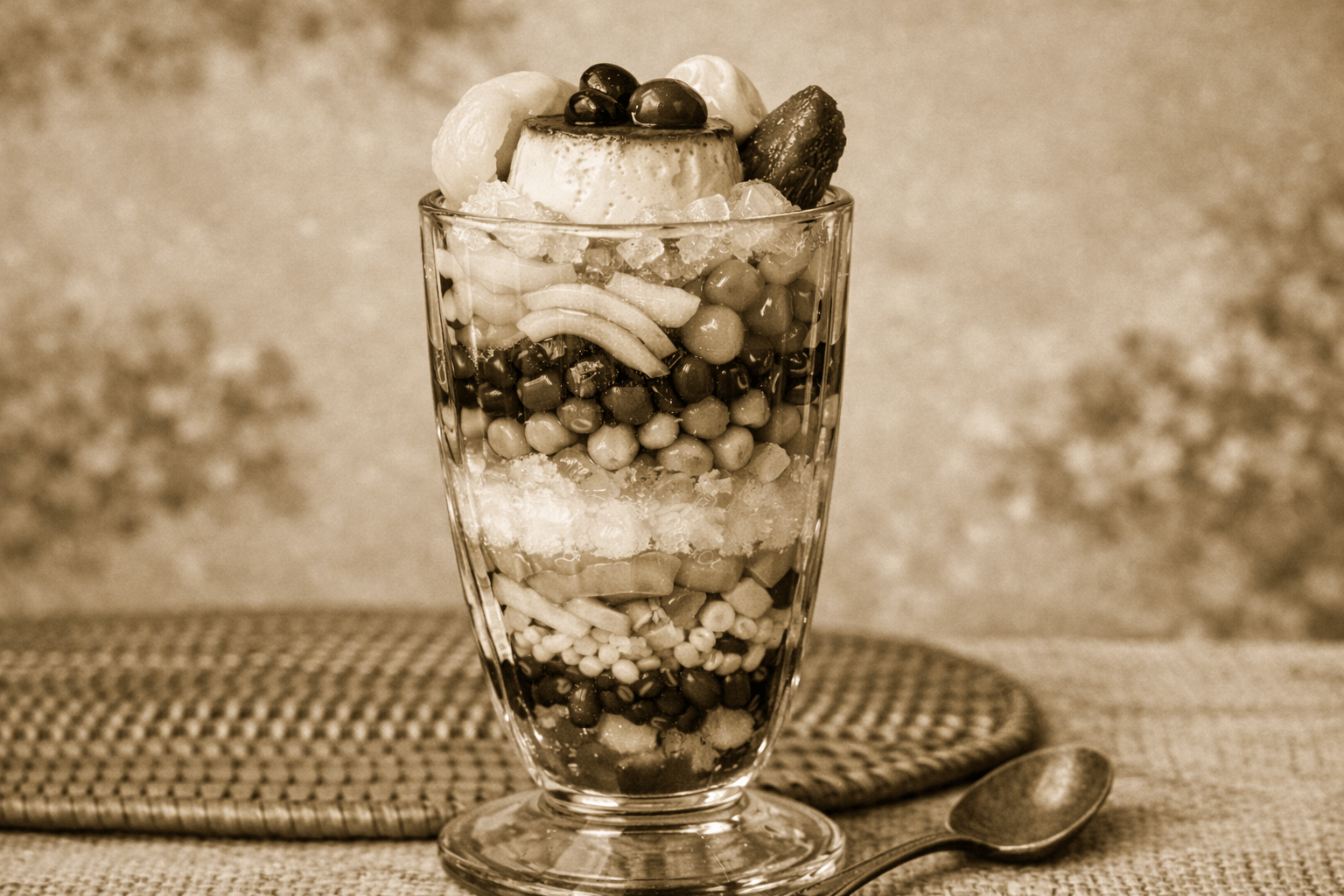
The story begins in the early 20th century, when Japanese immigrants settled in various parts of the Philippines. They brought with them a simple dessert known as kakigōri—a delicacy made of finely shaved ice topped with syrup or sweetened beans. As these communities integrated with the local population, their culinary influences seeped into Filipino kitchens. Over time, Filipinos began replacing red beans with local staples: caramelized bananas (saba), sweet corn, coconut jelly (nata de coco), and strips of preserved jackfruit. Where the Japanese version was minimalist, the Filipino reinterpretation became abundant, festive, and forgiving—anything sweet, colorful, and textural could be mixed in.
The arrival of ice was itself a historical milestone. During the American colonial period, ice was imported to the islands—an expensive luxury reserved for the elite. Eventually, ice plants were built in Manila and other urban centers, making it more accessible to the broader public. By the mid-century, ice shavers appeared in public markets, and by then, Halo-Halo had already evolved into a social dessert. It was no longer just about cooling down; it was about celebration.
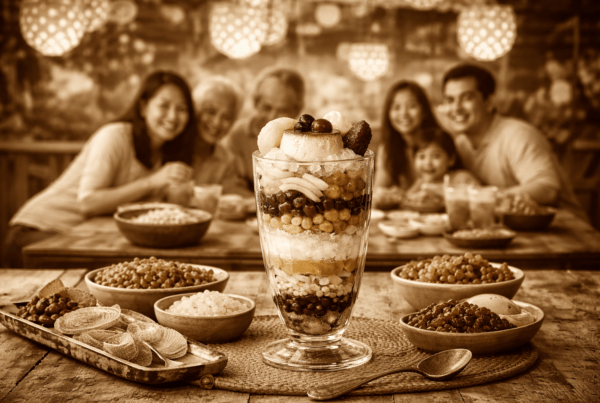
For many Filipinos, Halo-Halo became synonymous with the summer months. It was sold in plastic cups on sidewalks, scooped into tall glasses at family gatherings, and later served in fast food chains that tried to replicate—but rarely captured—the homemade charm of the original. The best versions weren’t found in restaurants. They were made in homes, where each ingredient was carefully prepared: the ube boiled and mashed with sugar and milk until smooth, the flan set gently in steamers, the coconut stripped and simmered into chewy macapuno, and the corn simmered in milk until it thickened into sweetness.
As much as it is a dessert, Halo-Halo is a reflection of Filipino character—joyous, inclusive, and constantly reinvented. It’s not precise, but it’s meaningful. It doesn’t demand uniformity. It invites participation. One person’s Halo-Halo might include pinipig and ice cream; another’s might favor a simple combination of corn, leche flan, and crushed ice with evaporated milk. No one is wrong. That’s the beauty of it.
What has remained unchanged through the decades is the sense of ritual that surrounds it. Halo-Halo must be mixed before eating. This act—of swirling the ingredients until they melt into one another—is a sensory metaphor for the Philippines itself. Colonial, regional, native, foreign—each element bringing its own weight and flavor, yet better when combined.
In that way, Halo-Halo is more than a dessert. It is an edible archive of the archipelago’s story: an island nation continually shaped by those who arrive, those who stay, and those who remember.